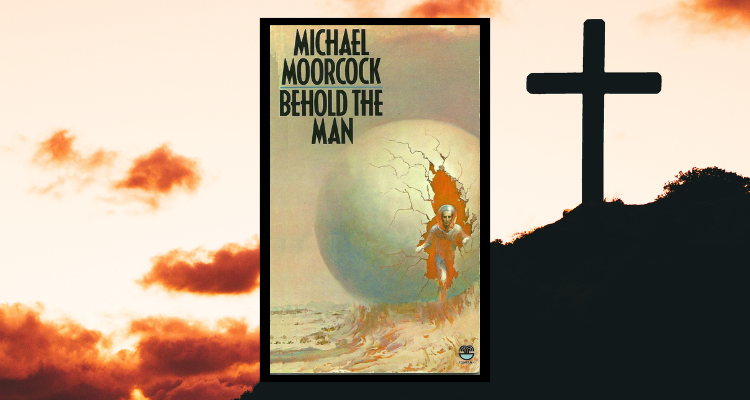
It’s a common question - if you could travel in time, to what point in history would you go? For Karl Glogauer, the protagonist of Behold the Man, the answer is never in doubt. After meeting an eccentric scientist who has devised an improbable time machine, the troubled Karl volunteers to visit 28 AD in a bid to meet Jesus Christ. He discovers that the Nazarene can barely speak, let alone save mankind. Karl takes an extraordinary step and becomes the Jesus we know from the Bible - despite knowing where his actions will lead.
Originally published as a novella in New Worlds magazine in 1966, Behold the Man is one of the most bold and unique of all time travel stories. Michael Moorcock won the Nebula Award for Best Novella for his work, and subsequently extended it into a short novel which was published in 1969. This story is a classic of new wave science fiction, which Moorcock championed as editor of New Worlds at the time. It is a fast-paced and intriguing exploration of religious belief, psychology, and the quest for meaning.
Behold the Man is largely unconnected with Moorcock’s huge corpus of influential novels; it is closer in style to his less familiar short fiction. As J.G. Ballard put it, the new wave was not about outer space, but about “inner space” - human thoughts, feelings, and ideas. Moorcock’s novel fits within this aspect of the movement. It is in large part a deep character study of Karl Glogauer, which documents extensively his personal traumas, frustrated hopes, and numerous neuroses.
The book is structured into two, alternating timelines. One narrative thread follows Karl’s life - from his childhood, through his various failed love affairs, and up to his meeting with outsider scientist Sir James Headington. The other thread documents Karl’s experiences in the Palestine of 28 AD, during which he first meets John the Baptist and later encounters an intellectually disabled Jesus. This structure is quite mind-bending in itself, in that the second thread occurs both before and after the first. Part of Moorcock’s masterstroke here is that both of these threads are compelling, and that they are so interconnected. Karl’s life as an adult in the 1960s is deeply troubled, and exists in the shadow of his traumatic childhood. He sabotages his own relationships with women, struggles with his homosexual tendencies, and flits restlessly from one belief system to the next in search of a meaning for his life. This prompts a fascination first with Jungian psychoanalysis, and later with the life of Jesus. 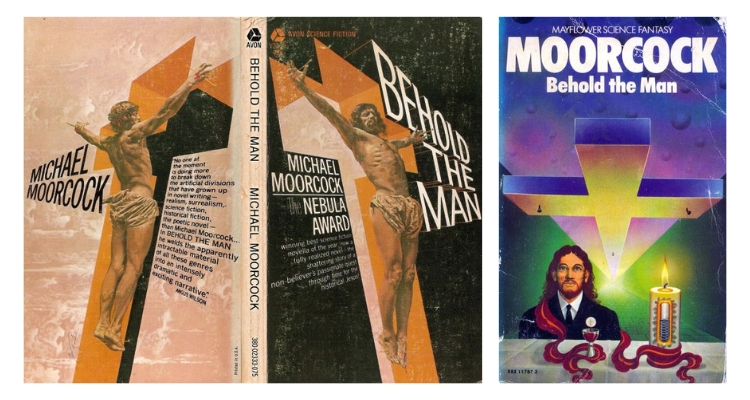
Two covers for Behold the Man. Robert Foster's striking wraparound cover for Avon, and one of the many covers Bob Haberfield did for Mayflower editions of Moorcock novels.
When confronted with a Jesus who is incapable of taking on his historical role, Karl acts in a way that is based on his desperate desire to believe in Christ. His knowledge of the Bible and of ancient Aramaic encourages John the Baptist and his Essene mystic sect to see him as a potential leader in the struggle against Roman oppression. First by accident, and then on purpose, Karl gradually occupies the historical role of Jesus. The fact that the novel’s ending is inevitable and predictable takes nothing away from its power.
Another of the story’s strengths is its efficiency. Even the extended, novel version is only 138 pages long in the current Gollancz paperback edition. Many of today’s writers would very likely over-extend the story, perhaps with needlessly detailed descriptions of ancient Palestine or of Jesus’ disciples. Moorcock knew that including these was not necessary. He captures the feel of the time and place in a concise way, and key figures like Judas Iscariot and Pontius Pilate appear only briefly. Like actors in a play, they deliver their lines and depart - it is Karl who leaves the lasting impression. 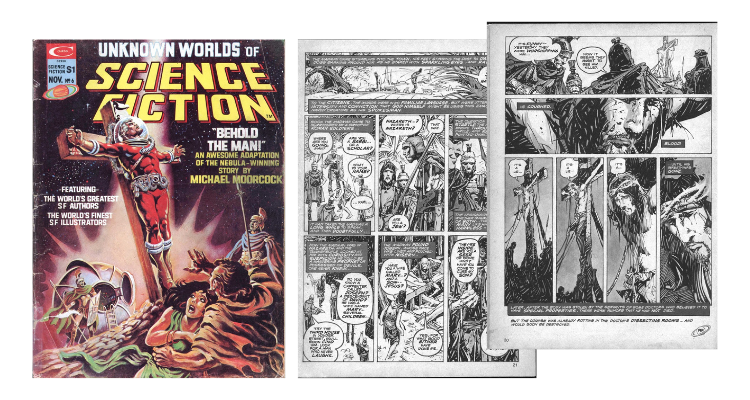
Perhaps surprisingly, Behold the Man was adapted by Marvel-adjacent Curtis Comics in "Unknown Worlds of Science Fiction" in 1975. It was written by Doug Moench and had art by Alex Niño.
Behold the Man is a world away from the violent action of the Elric or Corum books, but is every bit as fascinating. As a science fiction novel, Moorcock’s book is a very unusual prospect which leans heavily into the psychological focuses of the new wave. He takes a bold, even heretical, concept and delivers on it expertly. Karl is a frustrating and deeply flawed character, but it is easy to sympathise with his desire for meaning and with his difficult start to life.
While hardly one of Moorcock’s most typical books, Behold the Man may be one of his best - and is certainly a memorable contribution to the new wave from one of its foremost champions.
0 Comments
Your comment will be posted after it is approved.
Leave a Reply. |

About
Exploring classic science fiction, with a focus on the 1950s to the 1990s. Also contributing to Entertainium, where I regularly review new games. Categories
All
|